The Material That Enters the Cavity
A die casting press forces molten metal, such as zinc or aluminum alloy, into the cavity. The die opens once the metal has solidified. The tool review covers filling, venting, and ejection. See NADCA’s Explanation of Die Casting.
In typical thermoplastic injection molding, pellets melt in a barrel and enter the cavity through the nozzle and gate. Holding pressure follows filling. The mold opens after the part cools, then ejects it. See Protolabs’ Guide to Plastic Injection Molding and ENGEL’s Explanation of Holding Pressure.
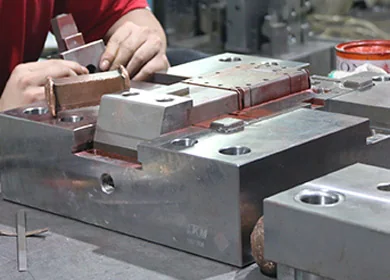
Tool Design and Sample Acceptance Compared
| Criteria | Die Casting Die | Plastic Injection Mold |
|---|---|---|
| Forming Material | Molten metals such as zinc and aluminum alloys | Molten thermoplastics such as ABS or PP |
| Machine Compatibility | Match the press’s injection method, die mounting, and ejection requirements | Match the injection molding machine nozzle, mold mounting, and ejection requirements |
| Tool Review | Metal flow, venting, thermal balance, ejection, and machining of the raw casting | Gate location, wall thickness, packing and cooling, shrinkage, and ejection |
| Sample Checks | Critical dimensions and appearance, with flash or internal porosity assessed for the application | Critical dimensions and appearance, with sink marks, warpage, or weld lines assessed for the application |
Both tools may use cavities, cores, gates, cooling, and ejectors. Geometry and process settings depend on the material, part design, and machine. See Examples of Cosmetic Defects in Molded Plastic Parts.
What to Recheck When the Material Changes
If a snap-fit housing changes from plastic to zinc, use the original model to check envelope and appearance. Reassess the snap fit, assembly clearance, drilling or tapping, and how the finished surfaces must mate after coating.
Review gates, parting, ejection, and machine compatibility for the new die. Share the current sample or model with your RFQ and identify the problem, such as a loose fit, finish quality, or load capacity. See Review Die Casting Tooling and Die Trials.
Die Casting and Injection Molding Comparison Video
What to Tell Engineering Before Choosing a Process
Describe the application, loads, service temperature, and assembly. Note any electrical insulation, surface finish, or cosmetic requirements. Compare samples and total cost for both routes against the same fit, acceptance, and volume requirements.
Have a die casting project?
Review My Die Casting Part